One camera and one lens can be enough for a day in Quanzhou if the limitation makes you look more carefully. The useful question is not how many landmarks fit into the frame. It is what connects the things you choose to photograph.
Quanzhou’s UNESCO listing tells a story of maritime trade through a group of religious, administrative, production and transport sites. A photography walk can follow one small part of that story without pretending to document the whole city in an afternoon.
Choose a subject before a route
Start with a simple visual theme: stone and shadow, the relationship between a temple and its street, or the way old and new shopfronts share a block. That gives you a reason to pause even when there is no famous view in front of you.
Kaiyuan Temple (开元寺) is one possible cultural anchor. Check current visiting rules and the rules for each space inside. A public entrance does not imply permission to photograph worshippers, ceremonies or every interior. Put the camera away where requested and ask before making a close portrait.
Work with the lens you brought
With a fixed or modest zoom lens, move only where visitors are allowed. Do not step into a road, cross a barrier or enter a private doorway to make a composition fit. If a whole building will not fit, photograph a relationship instead: an eave against the sky, a doorway and its paving, a tower above the street.
Make one broad frame, one medium view and one detail of a subject that interests you. This is an exercise in attention, not a requirement to create three nearly identical pictures. Sometimes the detail says more than the grand view.
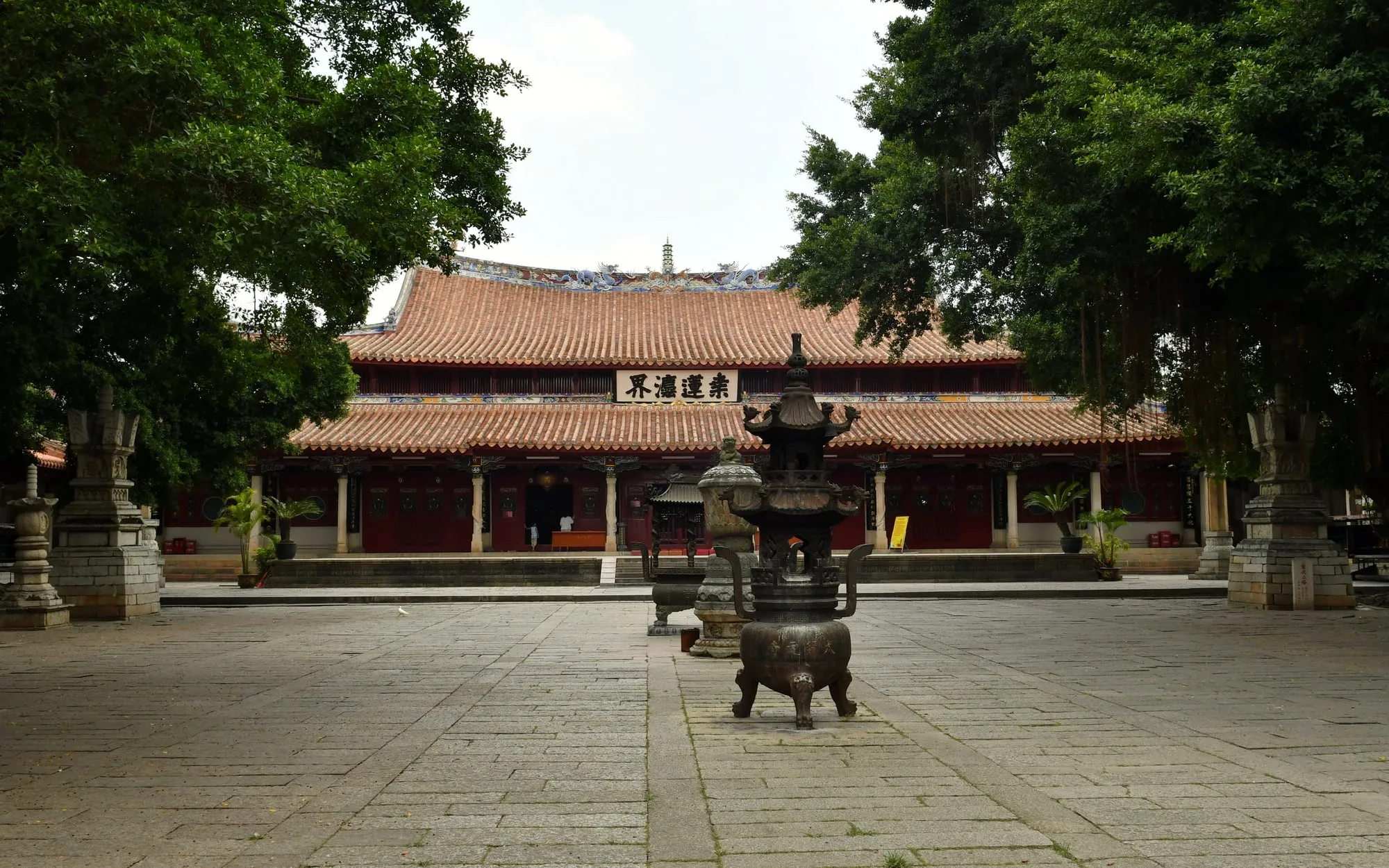
Kaiyuan Temple’s courtyard and main hall, July 2017. Tyg728 · Wikimedia Commons · CC BY-SA 4.0. Resized and compressed.
Give people room
A market or busy lane is a workplace before it is a subject. Keep doorways clear, buy or ask before lingering at a stall, and accept a refusal without negotiation. Do not photograph a person as anonymous “local colour” while ignoring their preference.
For buildings, read the interpretation available on site before assigning a meaning to a symbol. A carved motif may be attractive without your knowing its history. A caption that says what is visible is better than an invented explanation.
Edit before taking more
Stop for a drink and review a small selection. Look for repetition: ten doorways may show less of the day than one doorway, a street and the transition between them. Keep the images that make a coherent sequence, including an ordinary scene that explains scale or movement.
Before sharing, check names and locations. Separate a photograph’s capture date from the date you publish it. The strongest record of a city is not necessarily the largest collection; it is the one whose details you can stand behind.
Planning source
Quanzhou: Emporium of the World in Song–Yuan China, UNESCO, checked 1 November 2026 for heritage context. Photography permission remains specific to the venue and subject.
Image credits
- Cover: Tyg728 · Wikimedia Commons · CC BY-SA 4.0. Resized and compressed.
CC BY-SA image adaptations retain the linked licence.